Can I Take CBD with Other Medications?
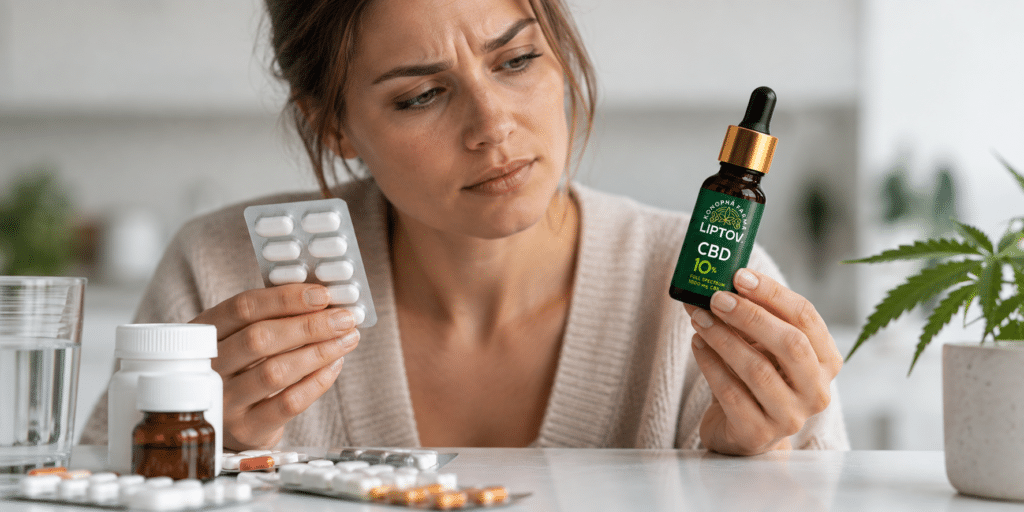
CBD and medications is a topic that concerns anyone who takes something regularly. The short answer: often yes, but not always and not without your doctor knowing.
CBD is processed in the liver by the same enzymes as a large proportion of commonly prescribed medications. This means it can alter their levels in the blood — sometimes insignificantly, sometimes enough to have clinical relevance.
The good news is that there is a simple way to find out whether this applies to you. And that most interactions can be managed by adjusting doses, not by stopping.
Why CBD and medications interact at all
The reason CBD and medications influence each other is straightforward. The liver uses a group of enzymes called cytochrome P450, or CYP450 for short, to process medications. The most important of these are CYP3A4, CYP2C19 and CYP2D6 — together they metabolise an estimated 60% of all prescription drugs.
CBD slows these enzymes down. Imagine a factory with five production lines suddenly asked to process twice the material. Something will pile up and wait.
In practice, this means a medication stays in the body longer and at a higher concentration than the prescribing doctor intended. For some drugs this doesn’t matter. For others — such as blood thinners — it can be a problem.
We discuss CBD’s hepatic metabolism in more detail in Does CBD Harm Your Liver or Kidneys?
The grapefruit test: the simplest way to check
This is the most practical piece of information in the entire article.
Grapefruit blocks the same liver enzymes as CBD. So a simple rule applies:
If the package insert for your medication warns against combining it with grapefruit, it is highly likely to interact with CBD as well.
Check the package insert under interactions. If grapefruit appears there, speak with your doctor or pharmacist before starting CBD.
It’s not a perfect rule — CBD and grapefruit don’t overlap entirely — but as a quick filter it works very well.
Which medications should not be taken with CBD
There are several groups where caution is most warranted. These are not absolute prohibitions, but combinations that belong under medical supervision.
Blood thinners
The best-documented and highest-risk interaction. This concerns warfarin, but also newer anticoagulants such as apixaban, rivaroxaban and dabigatran.
CBD slows the breakdown of warfarin, raising its level and the risk of bleeding. In published cases, patients who added CBD needed to reduce their warfarin dose by about a third.
What to watch for: unusual bruising, prolonged bleeding from minor cuts, bleeding from the gums or nose.
Do not attempt this combination without consulting your doctor and having your INR monitored regularly.
Antiepileptic drugs
A complex category, because CBD itself has anticonvulsant properties. Interactions have been documented with clobazam, valproate, phenytoin and carbamazepine.
CBD can raise or lower the levels of these drugs, potentially leading either to increased side effects or to breakthrough seizures. The combination of CBD and valproate also increases the risk of liver stress.
More on CBD for epilepsy is in our dedicated article.
Sedatives and benzodiazepines
Diazepam, alprazolam, clonazepam, zolpidem and similar medications suppress the nervous system. CBD can amplify this effect — not dramatically, but noticeably.
This manifests as more pronounced drowsiness, slowed reactions and difficulty concentrating. It’s relevant when driving or operating machinery.
Immunosuppressants
Cyclosporine, tacrolimus, sirolimus — medications given after transplants and for autoimmune conditions. They have a narrow therapeutic window, meaning even a small change in level has consequences.
The recommendation here is unambiguous: never start CBD without consulting your treating physician.
Other medications with documented interactions
- Statins (atorvastatin, simvastatin) — risk of muscle pain with elevated levels
- Some antibiotics (clarithromycin, erythromycin, rifampicin)
- Antihistamines — possible amplification of sedation
- Opioids — amplification of sedative effect; more in Is CBD Similar to Opioids?
- Antipsychotics — altered levels and possible amplification of side effects
- Antiretrovirals for HIV treatment
Can CBD be combined with antidepressants or blood pressure medication?
These are the two most common questions we receive on CBD and medications — and the answer to both is similar: usually yes, but with monitoring.
CBD and antidepressants
SSRI antidepressants (sertraline, escitalopram, citalopram, paroxetine, fluoxetine) and SNRI antidepressants (venlafaxine, duloxetine) are metabolised via CYP2D6 and CYP2C19 — the same enzymes CBD affects.
What may happen: the antidepressant level in the blood rises mildly. For most people this produces no noticeable change. For some, side effects may become more pronounced — nausea, drowsiness, headaches or sleep disturbances.
Practical recommendations:
- Inform your psychiatrist or GP before starting CBD
- Start with a low dose — 10–15 mg daily — and increase slowly
- Monitor for side effects during the first two weeks
- Never stop antidepressants on your own because of CBD; changes to psychiatric medication belong in the hands of a doctor
Extra caution is warranted when combining with tricyclic antidepressants (amitriptyline) and MAO inhibitors, where greater care is needed.
If you’re dealing with anxiety or stress, also see Does CBD Help with Anxiety? and Does CBD Help with Stress?
CBD and blood pressure medication
The situation here is slightly different, because CBD itself can mildly lower blood pressure. Combined with antihypertensives, these effects add up.
This is most relevant for:
- Calcium channel blockers (amlodipine, verapamil, diltiazem) — these carry a grapefruit warning
- Beta blockers (metoprolol, bisoprolol)
- ACE inhibitors (ramipril, enalapril)
What to watch for: dizziness when standing up quickly, weakness, fainting, unusually low readings on a blood pressure monitor.
Practical recommendations:
- Monitor your blood pressure for the first two weeks after starting CBD, morning and evening
- Keep a record and show it to your doctor
- Rise slowly until you’ve adapted
- If repeated dizziness occurs, reduce the CBD dose and seek advice
For most people with well-controlled blood pressure, this combination isn’t a problem — but measuring is worthwhile.
How to reduce risk when combining CBD with medications
A few practical steps to prevent interactions:
- Tell your doctor and pharmacist you take CBD. This is the most important point in the entire article. A pharmacist can check your medications against known interaction profiles in minutes.
- Start low. At 10–15 mg daily, risk is considerably lower than at 100 mg. See How to Dose CBD.
- Space out timing. If you take a medication in the morning, take CBD 2–4 hours later. This reduces competition for liver enzymes.
- Consider topical forms. Hemp ointments with CBD act locally and very little CBD reaches the bloodstream — so the risk of interactions is considerably lower. For joint or muscle pain this is a practical alternative to oral oil.
- Keep a record. Note down your CBD dose and any changes in how you feel. This is valuable information at medical check-ups.
- Don’t drink grapefruit juice alongside CBD and medications — the effects add up.
When to contact a doctor immediately
If you notice any of the following after starting CBD alongside medications, don’t delay:
- Unusual bruising or bleeding
- Marked dizziness, fainting or a feeling of losing consciousness
- Unusual drowsiness that disrupts normal functioning
- Confusion or difficulty concentrating
- Heart palpitations or an irregular pulse
- Yellowing of the skin or whites of the eyes
- Worsening of the condition your medication is treating
Frequently asked questions
Do I need to stop CBD before surgery?
Yes — it is recommended to stop at least 2 weeks before a planned procedure due to the effect on liver enzymes and potential interactions with anaesthetics. Tell your anaesthesiologist that you take CBD.
Can CBD interact with over-the-counter medications too?
It can. This mainly concerns ibuprofen and other NSAIDs with long-term use, antihistamines and some sleep medications. Occasional use of a single ibuprofen tablet is not a concern.
Is hemp ointment safer than oil if I take medications?
Yes. Topical products act locally and very little CBD reaches the bloodstream. If you’re managing localised pain and also taking high-risk medications, ointment is a more sensible choice than oil.
How long after a medication can I take CBD?
A gap of 2–4 hours is a reasonable compromise. It won’t fully prevent interaction, but it reduces competition for liver enzymes at the time of peak drug concentration.
Can I take CBD with alcohol?
Not regularly. Both suppress the nervous system and both stress the liver. An occasional glass of wine alongside a low dose of CBD isn’t a drama, but a regular combination is.
Summary
The question of CBD and medications has no universal answer — it depends on the specific medication, the dose and on you. Most combinations are manageable if your doctor is aware and can adjust dosing accordingly.
Two practical steps that will save you worry: check whether your medication has a grapefruit warning, and tell your pharmacist you take CBD. A pharmacist can check your medications in a few minutes.
And if you take drugs with a narrow therapeutic window — warfarin, immunosuppressants, antiepileptics — don’t start CBD without a consultation. Not because it’s prohibited, but because a small change in level there genuinely matters.
When choosing a product, go for oils with a laboratory certificate so you know exactly how much CBD you’re taking. At our farm under the Kriváň peak we grow hemp by hand without pesticides, and every batch of CBD oils has an independent analysis.
Sources
- Grayson L et al. Case report: Medical cannabis—warfarin drug-drug interaction. PMC
- Leafwell, CBD Drug Interactions List
- Drugs.com, Drug Interactions with Grapefruit Juice
- WHO Expert Committee on Drug Dependence, Cannabidiol Critical Review Report, 2018
Author of the article

Som jeden zo zakladateľov Konopnej farmy Liptov. Láska k prírode, pracovitosť, zmysel pre detail a túžba mať vlastné dielo, ma priviedli v roku 2019 ku krokom, kde som si spolu so svojím kamarátom založil Konopnú farmu Liptov. Postupne a trpezlivo budujeme silnú a stabilnú firmu tehlu po tehličke, aby sme svojou prácou pomáhali ľuďom a podporili Slovenskú ekonomiku, hospodárstvo a prírodu.
Other articles

Why CBD Doesn’t Work for Everyone: 8 Most Common Reasons
ou buy the oil, take it for two weeks and nothing happens. Yet your friend swears it changed thei...