Full-Spectrum, Broad-Spectrum and Isolate: What’s the Difference?
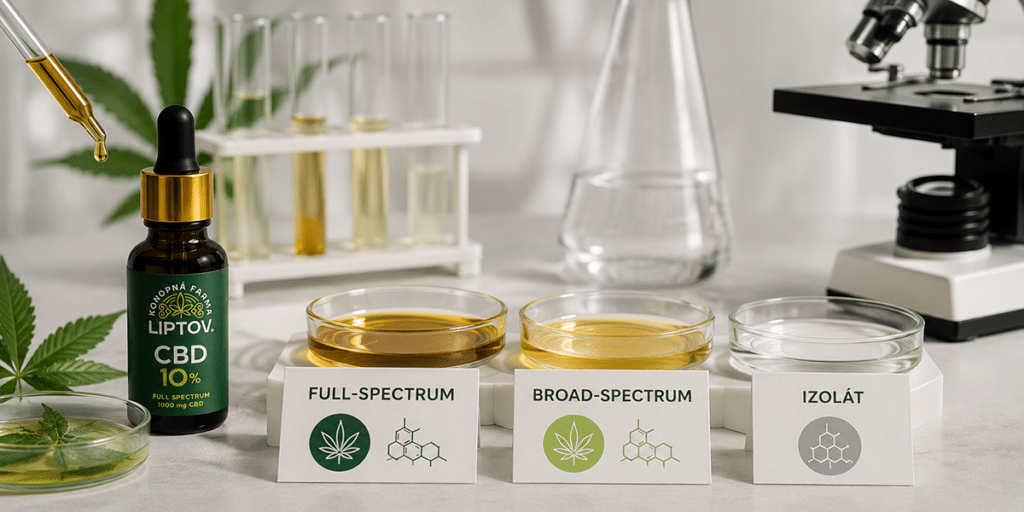
You’re choosing a CBD oil and the labels are full of words you’ve never seen before. Full-spectrum. Broad-spectrum. Isolate. They sound like marketing buzzwords, but they actually describe three distinct types of extract that differ in composition and how they work in the body.
The difference is fairly simple — and once you understand it, you’ll know exactly what to look for.
At a glance: what each type contains
| Full-spectrum | Broad-spectrum | Isolate | |
|---|---|---|---|
| CBD | Yes | Yes | (99%+) |
| THC | trace (<0.3%) | removed | No |
| Other cannabinoids (CBG, CBN, CBC) | Yes | Yes | No |
| Terpenes and flavonoids | Yes | (partially) | No |
| Entourage effect | strongest | moderate | none |
| Taste | more pronounced, earthy | mild | neutral |
| Risk on drug test | very low, but not zero | minimal | none |
Three products from the same plant, processed to different degrees. Let’s look at each in detail.
Full-spectrum: the whole plant in one bottle
Full-spectrum extract contains everything the plant naturally produces — CBD, dozens of other cannabinoids, terpenes, flavonoids and trace amounts of THC within the legal limit of 0.3%.
Think of it like the difference between a vitamin C tablet and a freshly squeezed orange. The tablet has one compound; the orange has vitamin C plus dozens of other compounds that work differently in combination than each one alone.
What you’ll find in there besides CBD:
- CBG (cannabigerol) — acts anxiolytically through different receptors than CBD
- CBN (cannabinol) — has a sedative effect, associated with sleep
- CBC (cannabichromene) — being researched for inflammation and mood
- Terpenes — linalool, myrcene, limonene, beta-caryophyllene; each with its own profile
- Flavonoids — plant antioxidants
The trace THC (less than 0.3%) is far too little to produce any psychoactive effect — we explain this in detail in Does CBD Get You High?. Its role is different: it contributes to the entourage effect.
Best for: most people seeking the strongest effect for anxiety, pain, sleep or inflammation. It is the most common and most researched form.
Broad-spectrum: almost everything, just without THC
Broad-spectrum is essentially full-spectrum from which THC has been removed through an additional process. The other cannabinoids and terpenes remain.
It sounds like the best of both worlds — and in some situations it is. The catch is that the THC removal process isn’t entirely without consequences. Some terpenes are lost in the process, so the entourage effect tends to be somewhat weaker than with full-spectrum.
Best for:
- People subject to regular drug testing at work or in sport
- Those who travel to countries with zero THC tolerance (such as Japan) — more in Travelling with CBD Abroad
- People who are sensitive to THC or prefer to avoid it for personal reasons
- Pregnant or breastfeeding women after consulting a doctor (though CBD is generally not recommended during pregnancy)
Isolate: pure CBD and nothing else
CBD isolate is a crystalline powder containing 99% or more pure cannabidiol. No other cannabinoids, no terpenes, no THC. It is tasteless and odourless.
That’s exactly why it’s used in pharmaceutical products — for example, Epidyolex, which is prescribed in Europe for certain forms of epilepsy, is based on highly pure CBD isolate. When a doctor needs precise dosing and wants to eliminate variables, isolate is the logical choice. More on that in CBD and Epilepsy.
Best for:
- People who need absolute certainty of zero THC
- Those who dislike the earthy taste of full-spectrum oils
- Cases where very precise dosing is required
- People with a documented sensitivity to certain terpenes
Downside: you miss out on the entourage effect. Available research suggests that isolate requires higher doses to achieve a comparable effect.
The entourage effect: why the whole works differently than the sum of its parts
This is the concept that explains the entire difference between the types — and it’s worth understanding.
The term entourage effect was introduced in 1998 by Israeli researchers Raphael Mechoulam and Shimon Ben-Shabat. Their hypothesis: compounds in cannabis that appear “inactive” on their own amplify the effects of the main ones. The whole therefore works differently than just the sum of its parts.
What the research actually shows
The most cited study is one published in 2015 in Pharmacology & Pharmacy, which compared a full-spectrum extract with pure CBD for inflammation. Finding: the full-spectrum extract produced a stronger anti-inflammatory response and its effect kept increasing with higher doses. Pure CBD showed a so-called bell curve — once a certain dose was reached, the effect stopped growing and began to decline.
More recent and methodologically rigorous is a double-blind study from Johns Hopkins in 2024. Twenty healthy adults completed nine sessions in which they inhaled either THC alone, the terpene d-limonene alone, or a combination. Result: limonene reduced the anxiety and paranoia induced by THC without changing its other effects. It was one of the first controlled human studies to directly demonstrate an interaction between a terpene and a cannabinoid.
What the other side says
To be fair: the entourage effect is not a settled matter. There are good-quality studies that did not confirm it — for example, work published in PMC that tested whether terpenes from cannabis act directly on CB1 and CB2 receptors. They didn’t. This doesn’t mean the entourage effect doesn’t exist, but that its mechanism is clearly somewhere other than direct binding to cannabinoid receptors.
The current consensus could be summarised like this: interactions between cannabis compounds are real and measurable, but their precise mechanism is not yet fully understood. For practical decision-making, this means full-spectrum has better data behind it, but it isn’t miraculous — it’s simply a somewhat more effective form.
How to choose: a decision guide
Choose full-spectrum if:
- You want the strongest possible effect
- You’re dealing with anxiety, chronic pain, sleep issues or inflammation
- You are not subject to drug testing
- You don’t mind a more pronounced earthy taste
- You want the product with the most research behind it
Choose broad-spectrum if:
- You are subject to drug testing at work or in sport
- You want most of the benefits without any THC
- You travel to countries with zero tolerance
Choose isolate if:
- You need absolute certainty of zero THC
- You dislike the taste of hemp
- You need very precise dosing
- You have a sensitivity to terpenes
For most people, full-spectrum is the most sensible choice — it has the best balance of effect and price and the most substantiated data. Our range of full-spectrum CBD oils starts at 5% for beginners and goes up to 15% for those who need higher doses. If you’re interested in other cannabinoids, take a look at our CBG oil.
Frequently asked questions
Will full-spectrum oil get me high?
No. THC content below 0.3% is far too low — a typical daily dose contains only fractions of a milligram, whereas a psychoactive effect requires 5 to 10 mg. A detailed calculation is available in Does CBD Get You High?
Is broad-spectrum truly THC-free?
In most cases yes, but it depends on manufacturing quality. Some products labelled as broad-spectrum may contain undetectable traces. If you need absolute certainty, choose an isolate with a laboratory certificate.
Why is isolate sometimes cheaper and sometimes more expensive?
Isolate is simpler to produce in large volumes, so the raw material tends to be cheaper. Pharmaceutically pure isolate with high quality requirements can, on the other hand, be more expensive than a standard full-spectrum oil.
Can I switch between types?
Yes, there’s no problem with that. When switching from isolate to full-spectrum, you may find you need a lower dose — precisely because of the entourage effect.
Which type is best for sleep?
Full-spectrum, ideally with a higher CBN content, which has a sedative profile. Broad-spectrum works too; isolate the least.
Summary
The difference between the three types of CBD is straightforward: full-spectrum contains the whole plant including trace THC, broad-spectrum is the same without THC, and isolate is pure CBD with nothing else. Full-spectrum has the strongest profile thanks to the entourage effect and the most research; broad-spectrum is a compromise for those who need to avoid THC; and isolate is the choice for maximum purity and precision.
Whichever type you choose, one thing always matters most — a laboratory certificate confirming that what’s in the bottle is what’s on the label. At our farm under the Kriváň peak we grow hemp by hand without pesticides and have every batch independently tested.
If you’re interested in getting started with dosing, see How to Dose CBD.
Sources
- Mechoulam R, Ben-Shabat S. An entourage effect: inactive endogenous fatty acid glycerol esters enhance 2-arachidonoyl-glycerol cannabinoid activity. European Journal of Pharmacology, 1998
- Gallily R et al. Overcoming the Bell-Shaped Dose-Response of Cannabidiol by Using Cannabis Extract Enriched in Cannabidiol. Pharmacology & Pharmacy, 2015
- Ferber SG et al. The “Entourage Effect”: Terpenes Coupled with Cannabinoids for the Treatment of Mood Disorders and Anxiety Disorders. PMC
- Finlay DB et al. Terpenoids From Cannabis Do Not Mediate an Entourage Effect by Acting at Cannabinoid Receptors. PMC
- WHO Expert Committee on Drug Dependence, Cannabidiol Critical Review Report, 2018
Author of the article

Študujem ekológiu, environmentalistiku a momentálne aj udržateľný urbanizmus, no o témy konopy sa zaujímam už od strednej. Najviac ma ale fascinuje to ako veľa rôznych vecí sa z jednej rastliny dá vyrobiť. Dá sa jesť, lieči ľudí aj planétu, môžete si ju obliesť, postaviť z nej dom aj auto. Keby bolo na mne, pestovala by sa povinne, haha!
Other articles

Can I Take CBD with Other Medications?
CBD and medications is a topic that concerns anyone who takes something regularly. The short answ...